
The True Cost of a Weak Small Business Online Presence
Imagine this:
Someone in your town needs exactly what you offer. They ask a friend for a recommendation. The friend says your name.
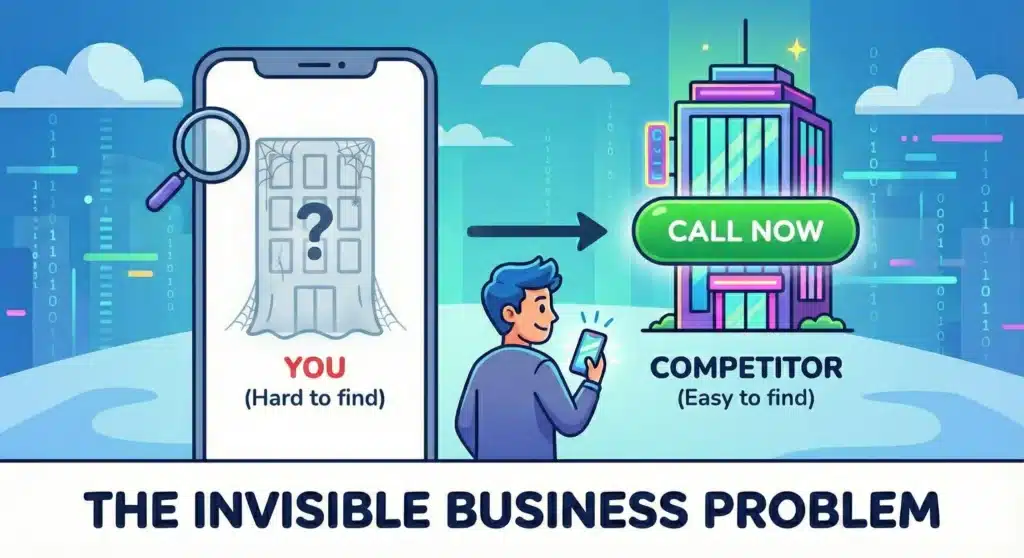
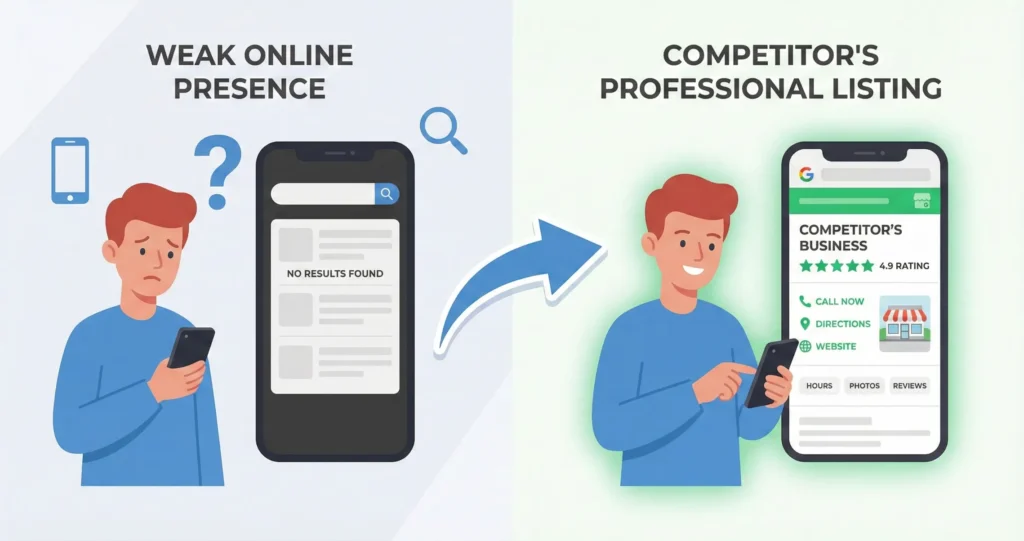
The person pulls out their phone. They type your business name into Google. And they find… almost nothing.
No clear information. No reviews. No way to know if you’re trustworthy.
So they scroll down. They find your competitor instead. And they call them.
This happens more often than you think.
You’re not losing to “better” businesses. You’re losing to businesses that are easier to find.
The good news? This is fixable.
In this post, you’ll learn:
- Why customers choose your competitor (even when you’re better)
- How to calculate how many leads you’re missing
- A simple 30-day plan to start getting those customers back
Let’s dive in.
Why Customers Choose Your Competitor (Even When You’re Better)
The “Invisible Business” Problem
Most business owners believe that good work speaks for itself. If you do great work, customers will come. Right?
Not anymore.
Today, people research before they reach out. Even after a friend recommends you. They want to see proof that you’re real and trustworthy.
Key Fact: About 70–80% of people search online before contacting a local business—even for a referral.
If they can’t find you, they move on. It’s that simple.
What Your Competitor Is Doing Differently
Your competitor might not be better than you. They might not even be as good.
But they’re easier to find and trust.
When someone searches for them, they see:
- Clear list of services
- Business hours and location
- Customer reviews
- A way to contact them in seconds
They’ve made it easy for a stranger to say “yes.”
You can do the same thing.
The Silent Leak in Your Sales Funnel
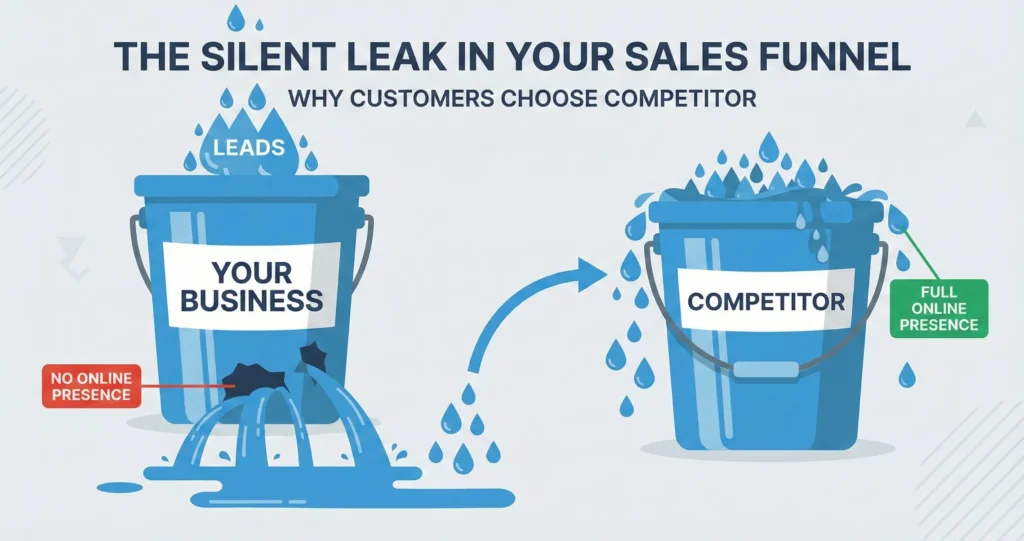
Think of your business like a bucket of water. Every lead is a drop of water.
You’re pouring water in (through referrals, social media, word of mouth). But if there’s a hole in the bucket, the water leaks out.
That hole? It’s your missing online presence.
People hear about you. They get curious. But then they can’t find enough information to trust you. So they leave.
📌 Callout: You may be generating interest—but losing conversions because there’s no credible “next step” for the customer.
This is the silent cost of being invisible online.
How to Calculate the Real Cost of Being Invisible Online
A Simple Formula to Estimate Missed Leads
Here’s a quick way to guess how many customers you’re losing.
Formula:
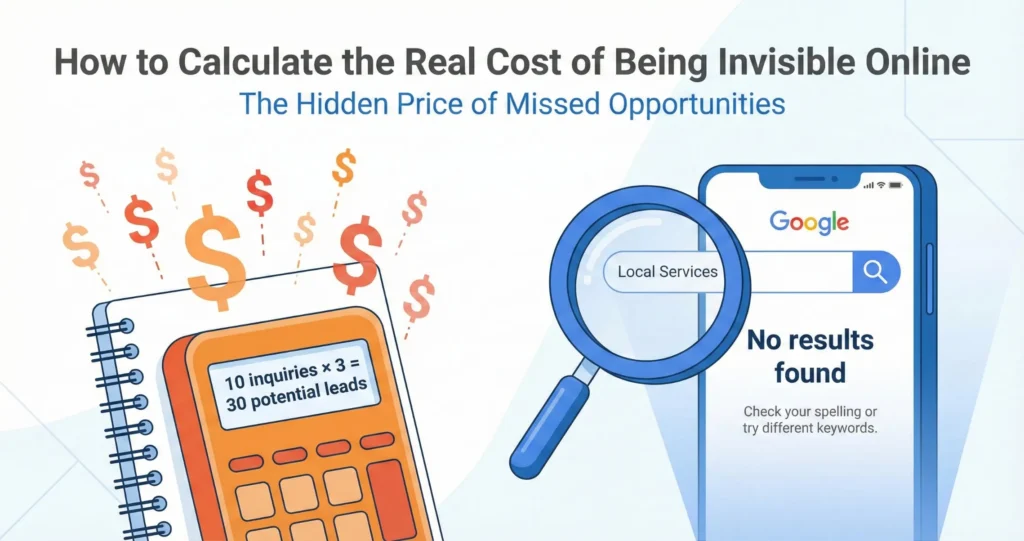
(Monthly inquiries you get) × 2 or 3 = Potential inquiries you're missing
Let’s say you get 10 calls or messages per month. Your competitor, who shows up easily online, might be getting 30.
That means you’re potentially missing 20 leads every month.
Now do the math:
If your average job is worth $500, and you’re missing 10 leads per month, that’s $5,000 walking to your competitor.
The “Google Your Business Name” Test (15-Minute Audit)
Want to know how you look online right now? Try this simple test.
Step 1: Open Google. Search your exact business name. What shows up?
Step 2: Search “[your service] + [your city].” Do you appear at all?
Step 3: Check Google Maps, Yelp, and Facebook. Is your info correct?
📌 Callout: If customers can’t find your business, they assume you’re not serious—or worse, not real.
Write down the top 3 gaps you find. These are your starting points.
What “Invisible” Actually Costs You
Being invisible online costs more than just leads.
Time: You waste hours answering the same questions—your hours, your prices, your location.
Trust: Serious clients skip you because you “don’t look legit.”
Energy: You work hard but don’t grow. It’s frustrating.
One small business owner said it best:
“I was answering the same 5 questions on WhatsApp every single day. It was exhausting—and I was still losing people who wanted answers faster.”
How to Recover Lost Customers Without Increasing Your Ad Budget
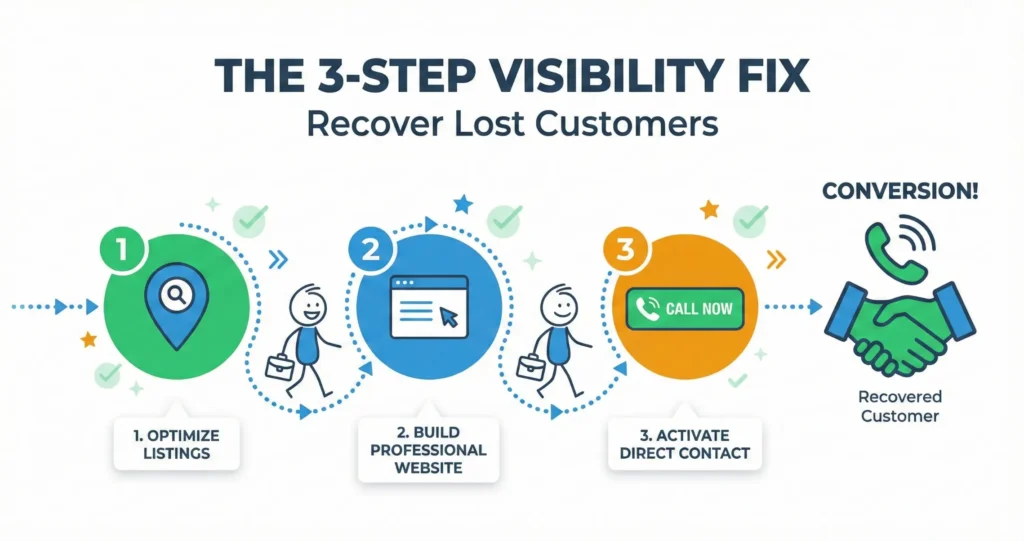
The 3-Step “Visibility Fix” You Can Start This Week
You don’t need expensive ads to get more customers. You need to be findable and trustworthy.
Here’s a simple plan:
- Claim your Google Business Profile. It’s free. It takes 20 minutes. It puts you on Google Maps.
- Create a simple one-page online presence. Include: services, contact info, hours, and reviews.
- Add one clear call-to-action. Example: “Call now” or “Request a free quote.”
This alone puts you ahead of 60–70% of local competitors.
What Information Customers Actually Need
When someone visits your page, they’re looking for 5 things:
- Services – What do you do?
- Pricing – How much does it cost? (Even “starting at $X” helps.)
- Location/Hours – Where are you? When are you open?
- Contact – How do I reach you?
- Proof – Reviews, photos, testimonials.
If ANY of these are missing or hard to find, you lose trust.
📌 Action Step: Write out these 5 things for your business today. Even in a notes app. This is your foundation.
How a Simple Website Filters Out Bad Leads
Here’s a hidden benefit of a clear online presence:
It pre-qualifies your customers.
When people find your info online first, they already know:
- What you offer
- How much it costs
- How to reach you
This means fewer “just browsing” calls. More “ready to book” inquiries.
You stop competing on price alone. You start competing on clarity and trust.
Your 30-Day Action Plan to Stop Losing Customers to Competitors
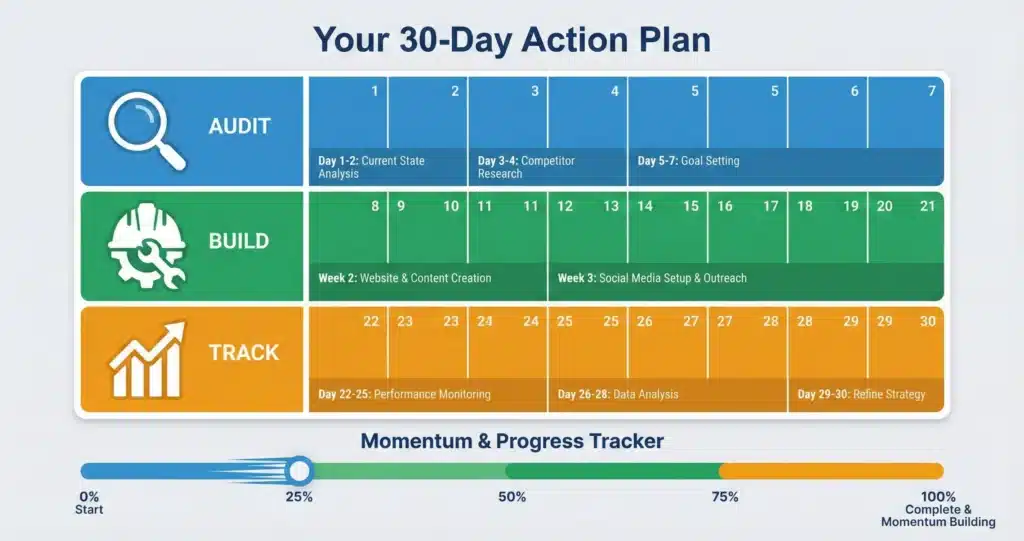
Week 1: Audit and Clarify
- Do the “Google Your Business Name” test.
- List your top 5 services, your hours, and your contact info.
- Identify your #1 visibility gap. (No Google listing? No website? Outdated info?)
Week 2–3: Build Your Online “Home Base”
Option A: Set up or optimize your Google Business Profile. (Free and fast.)
Option B: Create a simple one-page website. (Affordable and professional.)
Add your 5 key pieces of information. Add one clear call-to-action.
Week 4: Track and Improve
- Track your inquiries. Use a spreadsheet, notebook, or simple CRM.
- Ask new customers: “How did you find me?”
- Goal: Get at least 2–3 extra leads this month from your new visibility.
📌 Simple Tracking Template:
| Date | Lead Source | Outcome |
|---|---|---|
| Jan 5 | Google search | Booked |
| Jan 7 | Referral | Quote sent |
Conclusion: Stop Losing Customers To Competitors
Let’s recap:
- Your competitors aren’t always better. They’re just easier to find and trust.
- You can estimate your missed leads with a simple formula.
- A clear small business online presence is the most cost-effective way to stop the leak.
You’ve already done the hard work of building a reputation.
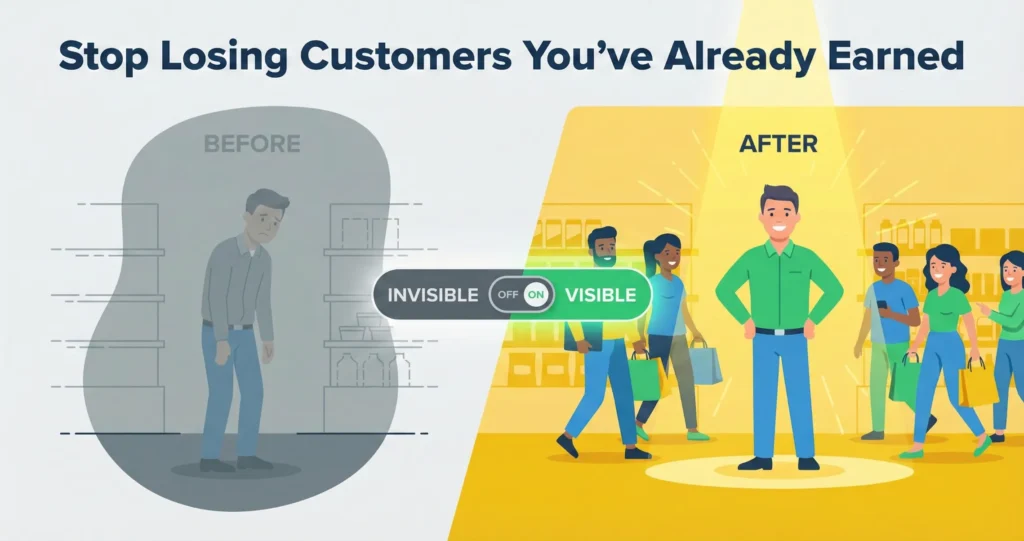
Don’t let invisible gaps cost you the customers you’ve earned.
Ready to Take the Next Step?
Start with the 15-minute audit above. Find your biggest gap. Fix it this week.
Or, if you’d like help building a simple, professional online presence that works for your business—reach out for a free consultation.
Your customers are searching for you right now. Make sure they find you.
Frequently Asked Questions
How do I know if customers are choosing my competitors over me?
There are several warning signs. First, search for your business name on Google. If competitors appear first, customers likely contact them instead. Second, ask new customers how they found you. If most say "word of mouth only," you're missing online searchers. Third, check if your phone inquiries have dropped while your industry grows. These signs suggest customers find competitors before finding you.
Why do customers trust businesses with websites more than those without?
A website acts like a digital storefront that's open 24/7. It shows customers you're a legitimate, established business. People can see your services, prices, reviews, and contact information instantly. Without a website, customers may wonder if your business is real, temporary, or unprofessional. Studies show 75% of consumers judge a company's credibility based on their online presence.
How much does a small business website cost?
A professional small business website typically costs between $500 to $5,000 for initial setup. Basic websites with essential information start around $500-$1,500. More advanced sites with booking systems or e-commerce features range from $2,000-$5,000. Monthly maintenance costs run $50-$200. Many web developers offer payment plans to make it affordable for small businesses.
Can I rely only on social media instead of having a website?
Relying only on social media is risky. Platforms can change their rules, reduce your reach, or even ban your account without warning. You don't own your Facebook or Instagram page—the platform does. A website is property you control completely. The best strategy combines both: use social media for engagement and a website as your permanent online home where customers can always find you.
How long does it take to build a small business website?
A basic small business website takes 1-2 weeks to build. This includes planning, design, content creation, and testing. More complex websites with multiple pages, booking systems, or online stores may take 3-6 weeks. The timeline also depends on how quickly you provide content like photos, service descriptions, and business information to your web developer.
What information should my small business website include?
Every small business website needs these essentials: your business name and what you do, services or products with clear pricing, contact information (phone, email, address), business hours, an about page telling your story, customer reviews or testimonials, and clear calls-to-action like "Call Now" or "Get a Quote." Adding photos of your work and team builds extra trust.
How can a website help me get better quality leads?
A website pre-qualifies customers before they contact you. When you display your services, prices, and service areas clearly, only interested customers reach out. This saves time answering questions from people who can't afford you or live outside your area. Contact forms can ask qualifying questions upfront. The result: fewer tire-kickers and more serious buyers ready to purchase.
Why Relying Only on Social Media or Word of Mouth Is Risky
The Platform Dependence Trap
Many small businesses rely only on Instagram or Facebook. It feels free and easy.
But here’s the problem: you don’t own those platforms.
What happens if your Instagram account disappears tomorrow? All your content, followers, and messages—gone.
A strong small business online presence means having a “home base” you control.
Why “Word of Mouth Only” Quietly Stalls Growth
Referrals are powerful. But they have a ceiling.
When someone recommends you, what happens next?
If there’s nowhere to send them, the momentum dies. They search for you, find nothing, and forget.
A proper online presence amplifies word of mouth. It doesn’t replace it—it makes it work better.
📌 Callout: Think of it this way: Referral → Google search → Nothing found = Lost lead. Referral → Google search → Professional info = Converted lead.
The Trust Gap: “Chat Only” vs. Professional Presence
Serious, high-value clients judge businesses by what they see online.
A scattered WhatsApp catalog or an outdated Facebook page signals “small-time.”
A simple, clear online presence signals “established and trustworthy.”
Quick trust checklist:
If you’re missing these, you’re losing trust before the conversation even starts.